Wednesday, 21 December 2016

Gabriel fram heven king

Everyone loves a good Christmas carol and though most of the ones we are familiar with today are from Victorian times when Christmas as we now think of it was invented, there are some wonderful ones from earlier centuries when it was a purely religious festival. One of my favourites dates back to the 13th century and was actually mentioned by Chaucer in The Miller's Tale where it is sung by the clerk Nicholas. Chaucer calls it by its Latin title of Angelus ad virginem but there is an English version too which I prefer because of the rich and robust sound of the words and a greater sense it gives you of being taken back to the Middle Ages. The song is probably French in origin but it adapts very well to anglicisation. It has a wonderful lilting melody and like many carols you feel you could dance to it. It certainly has a feeling of joy. Wikipedia says it was probably Franciscan in origin and it does have that sweet simplicity you would associate with St Francis.

The song tells the story of the Annunciation when the angel Gabriel appears to the Virgin Mary to announce her divine destiny and ask her if she will accept it. Her humility and grace when faced by this stupendous news is deeply touching. Here she is confronted by a great angel of the Lord and all she asks is how this thing can happen since she is a maid. Nothing about herself. When the miracle is explained to her she accepts it instantly and gives herself over completely to the task.

In this recording by St George's Canzona the tune is given a rather rumbustious folk music performance which suits it quite well though the sense of mystery might be somewhat lacking. Only the first verse is sung.


This is a more reflective performance, perhaps more in keeping with the momentousness of the occasion. All the verses are sung.


Original English version with modern translation in italics

Gabriel, fram hevene king
Sent to the maide sweete,
Broute hire blisful tiding,
And faire he gan hire greete
"Heil be thu, ful of grace aright,
For Godes Sone, this heven-light,
For mannes love
Wil man bicome
And take
Fles of thee, maide bright,
Manken free for to make
Of senne and devles might."

Gabriel, from heaven's king
Sent to the maid sweet,
Brought her blissful tidings,
And fair he did her greet:
"Hail be thou, full of grace aright,
For God's Son, this heaven's light,
For man's love
Will man become
And take
Flesh of thee, maiden bright,
Mankind free for to make
From sin and devil's might."

Mildelich him gan andswere
The milde maiden thanne:
"Wichewise sold ichs bere
A child withhute manne?"
Th'angle hir seid, "Ne dred tee nout;
Thurw th'oligast sal been iwrout
This ilche thing
Warof tiding
Ich bringe.
Al manken wurth ibout
Thurw thine sweete childinge,
And hut of pine ibrout."

Gently him did answer
The gentle maiden then:
"In what way can I bear
A child without a man?"
The angel said, "Fear thee naught;
Through the Holy Ghost shall be wrought
This same thing
Of which tiding
I bring.
All mankind will be redeemed
Through your sweet child
And delivered from suffering."

Wan the maiden understood
And th'angles wordes herde,
Mildelich with milde mud
To th'angle hie andswerde:
"Ure lords thewe maid iwis
Ich am, that her aboven is.
Anenttis me
Fulfurthed be
Thi sawe,
That ich, sith his wil is,
A maide withhute lawe
Of moder have the blis."

When the maiden understood
And the angel's words heard,
Gently with a gentle mind
To the angel she answered
"Our Lord's serving maiden indeed
I am, who here above is.
Concerning me
Fulfilled shall be
Your saying
That I, since his will it is,
A maiden, without a husband
Of motherhood will have the bliss."

Th'angle went awei mid than
Al ut of hire sighte
Hire wombe arise gan
Thurw th'oligastes might.
In hire was Crist biloke anon
Sooth God, sooth man in fles and bon,
And of hir fles
Ibore was
At time,
Warthurw us kam good won.
He bout us ut of pine
And let im for us slon.

The angel then departed
All out of her sight
Her womb to arise began
Through the Holy Ghost's might.
In her was Christ soon enclosed 
True God, true man in flesh and bone,
And of her flesh 
Born he was
In time,
In this way good fortune came to us
He bought us out of pain
And was for us slain.

Maiden moder makeles,
Of milche ful ibunde
Bid for us im that te ches,
At wam thu grace funde,
That he forgive us sen and wrake,
And clene of evri gelt us make;
And heven-blis
Wan ure time is
To sterve
Us give for thine sake
Him so her for to serve
That he us to him take.

Spotless maiden mother 
Of mercy full abounding,
Pray for us to him who chose you
With whom you found grace,
That he forgive us sin and vengeance
And cleanse us of all our guilt 
And heaven's bliss
When our time has come
To die
Grant us for thy sake
Him so here for to serve
That he us to him take.


Monday, 19 December 2016

What is Christmas? More than the Nativity

Christmas is a complex and multi-layered celebration and feast.

Christians are correct in pointing out that it is most importantly about remembering and celebrating the Birth of Christ; but neo-pagans and other non-Christians are also correct that there was already a Winter Solstice-related feast before Christ - and this remains an important aspect of the event, especially in relation to the character of Father Christmas or Santa Claus.

I have nearly always found Christmas to be a special time of year, including when I was not a Christian; but being Christian certainly adds roots, significance and reality to the occassion.

The pre-Christian aspects could be termed both astronomical and biological. The astronomical aspect is presumably a consequence of Christmas being just after the Winter Solstice; and suggests that there must have existed a sophisticated scientific priesthood able to measure the length of days; and detect when the shortest day had just been passed so they could begin to organise a celebration of the (true) New Year.

The biological aspect was that there was still plenty of stored food and fuel to stage a feast - only tempered by the need to keep enough in store to see enough people through the 'hungry gap' of spring, and until the next growing season brings fresh supplies. 

These are good reasons for a post-Solstice celebratory feast - but this would be of spiritual significance only insofar as there was a society where Sun and The Light were accorded the status of deity. The aptness for celebrating the birth of Christ is obvious; and the cultural elaboration of the Nativity story created a very special time of year: when the spiritual comes closer to the everyday than at any other point of the calendar.

Let us all at Christmas be sensitively aware of this fact; and alert for those communications and intuitions which we may now most confidently expect.

Friday, 16 December 2016

Roger Lancelyn Green - his critical legacy


A very interesting piece by Chris Calderon at the 'Hogwarts Professor' blog discusses the critical work of Roger Lancelyn Green, and his mythopoeic musings:

http://www.hogwartsprofessor.com/guest-post-christmas-gift-list-4-forgotten-inkling-the-writings-and-legacy-of-roger-lancelyn-green/

This can be seen in context of the earlier post from John Fitzgerald about RLG's retellings of classic myths and legends:

http://albionawakening.blogspot.co.uk/2016/09/roger-lancelyn-green-storyteller-and.html

Altogether, it is clear that Lancelyn Green has much of relevance to contribute to Albion Awakening!

Thursday, 15 December 2016

Two Modern Saints

A sentence in John Fitzgerald's recent post set me thinking. He wrote "The body of work left behind by the Inklings has helped re-mythologise the world and baptise the contemporary imagination". I haven’t read much by any of the other Inklings and I hadn’t even heard of them when growing up, but that sentence sums up the effect that Tolkien and CS Lewis had on me as a child. I’m sure they had a similar effect on countless others too. Indeed, I sometimes think that without them (and a few others but them principally), children growing up in the mid to late 20th century would have been left almost completely spiritually bereft.  Most of us had very little exposure to real spiritual truths and what we did have seemed formal and remote. But the stories of these two writers brought the spiritual world alive and did so (and this I think is very important) in a way that not only opened up the imagination but was also Christian.  The world was re-enchanted and done so in the light of Christ.

Modern Christianity often seems like a fire that has burnt itself out. Whether that is because of the paucity of real saints (saints are the lifeblood of any religion) or because it has lost touch with its roots or because it has become infected with social and political ideologies or because it is now more concerned with the letter than the spirit or because it has desacralized itself or because it frequently denies the truth and power of its own mythology and symbolism or because it has severed its connection with the imagination or because it focuses too much on this world and not enough on the next, is almost beside the point. (Actually all these things are linked). The fact is it has lost its glowing and full-bodied colours of yore, its sense of being lit from within, and become a black and white thing of two dimensions. And with its truth attacked from the outside and its vitality sapped from within, as well as a tendency to accommodate itself to what is trying to destroy it, it is now in many ways a faint shadow of its former self.

But, as John Fitzgerald pointed out, Tolkien and CS Lewis helped revive Christianity by re-establishing it in the world of the imagination. The former covertly, the latter more obviously but they both did it and they did it in a way that many people either didn’t notice or didn’t much care about if they did, thus getting beneath the prejudices instilled in the modern mind. Furthermore they brought back a sense of Tradition which after the Second World War appeared to have been completely abandoned by all the clever people intent on building their soulless world of modernity. I mean by Tradition a connection to real things, both natural and spiritual, that humanity had established over centuries but which was in danger of being swept away by those, more or less the entirety of the intelligentsia in the West, who preferred ideology to truth.

Running parallel to this idea of the restoration of poetry and imagination to religion was something else. Both Tolkien and Lewis recognized the reality of evil and taught the necessity of fighting it. In a way that’s what their books were all about. At the time they were writing even many Christians were embarrassed by the idea of the devil, preferring to see good and evil in terms of impersonal psychological principles. But our two writers knew better and in this, as in many other ways, they were prophets. Now anyone who is serious about trying to understand the spiritual world knows that dark forces, demons, call them what you like, exist and have tremendous power in this world which must be resisted. They cannot be compromised with. The best way to fight them is through handing oneself over to God and doing his will but this is not a passive thing as it was not for Gandalf or Frodo or any of the sons and daughters of Adam sent into Narnia to help restore it when things were going badly. It requires trust and hope and love of the good, and soldiering on doing one’s duty as Frodo and Sam did even when all seems lost. Pacifists don’t fight and they don’t win either. Obviously I’m not saying that one should never turn the other cheek but resist not evil does not mean giving way to it.

I said they were prophets. Much of what Tolkien and Lewis wrote can be seen to apply to the present day demonic assault on mankind. I'm thinking of Saruman and the Scouring of the Shire (already started in Tolkien's day but now everywhere and seemingly irreversible) or even the whole of The Lord of the Rings, and, in particular, The Last Battle and That Hideous Strength. The Ring can be many things but it is certainly not inappropriate to relate it to modern computer technology which gives us great power but at what inner cost? I also regard the depiction of a small band of men and women of true hearts and good will working with the inner powers against the demonically inspired forces of a corrupt Establishment, as depicted in That Hideous Strength, to have more than a touch of truth to it.


I wrote in an email to Bruce Charlton that these men were probably saints but that they, especially Tolkien, would almost certainly reject that title and look with extreme displeasure on any fool who gave it to them. Well, they’re not here to do so and I don’t suppose they care from where they are now. But if saints are those who faithfully carry out the will of God and work for him on this Earth then I don’t see why not. These two men performed a great work and are surely responsible for bringing many people to and, just as important, keeping them in the way of Christ over the last half century or so. They re-illuminated a light that was in danger of going out and did so in a way that inspired millions. In their stories, and in the case of Lewis, his religious writings, they not only provided lifeboats for sensitive souls drowning in a sea of atheistic materialism, they also gave us spiritual weapons to fight ignorance and evil. My, at the time, 9 year old son said to me a few years ago that The Lord of the Rings seemed more real than reality, and, of course, it is because it better reflects the truth in reality than what passes for reality in this world now.

Tuesday, 13 December 2016

The Inklings - Heralds of the Coming Christian Renaissance


I once claimed, in response to a post on Bruce Charlton's Notions, that J.R.R. Tolkien and C.S. Lewis could be viewed as twentieth-century incarnations of the 'two witnesses' referred to in the Book of Revelation. That was silly and hyperbolic, yet my sense remains that the Inklings in general, and these two in particular, were sent by God to carry out a great creative work which would echo and resound and have long-term repercussions for good in the world.

At first sight this might appear questionable. The Lord of the Rings and the Narnia books were published in the 1950s. Since then, the materialist worldview, ably assisted by social and economic liberalism, New Age 'spirituality' and post-modern vacuity, has made great strides in hollowing out the deposit of faith and culture that the West still possessed, albeit in diminished fashion, immediately after the Second World War (when Lewis's That Hideous Strength and Charles Williams' All Hallows Eve were published). 

'What use were Lewis and Tolkien then?' a cynic might quibble. One could equally turn the question around, however, and ask, 'But what if they never existed? What if they never wrote a word? What if their words went unheard? How much more precipitous might the decline have been?'

It's staggering when you think about it, the amount of people - young people in the main - who, without Lewis and Tolkien, would have been deprived of such a fine and noble imaginative vision, such a potent alternative to the drab secularism masquerading as freedom which sets, it seems, so much of the world's agenda today.

I say 'seems', because its power base is dissolving as I write. Its hold over the imagination is weakening. Liberal humanism has become shouty and shrill. It no longer motivates, unshackles or inspires. Its future appears limited, and the Inklings, I feel, have played a significant role in challenging and undermining its flat, one-dimensional, increasingly joyless manner of experiencing the world. But that's just the start. The Inklings story will run and run. Because what their writings point towards is nothing less, to my mind, than the great Christian renaissance to come - the 'Age of the Holy Spirit' prophesied by Joachim of Flore in the twelfth century and Nicholas Berdyaev in the twentieth.

The reformers of the Second Vatican Council, to take the Catholic perspective I know best, sensed something of this approaching change, I think. They realised that what had become a sometimes rather rules-obsessed Tridentine Church might struggle to inspire hearts and minds in the modern era. Their (or their interpreters) mistake, however, was to throw the baby out with the bathwater, sidelining the sacred and casting off tradition in a doomed attempt to appear 'relevant' to a Zeitgeist which was already, in the late 1960s, shifting and morphing into something quite brazenly anti-Christian.

The reformers, unlike the Inklings, lacked imagination. Their 'Spirit of Renewal', one feels tempted to conclude, has enjoyed its greatest successes only in de-mythologising large swathes of Catholic life. The body of work left behind by the Inklings, on the other hand, has helped re-mythologise the world and baptise the contemporary imagination. The Christianity of the future prefigured throughout the Inklings' oeuvre is different to post-Vatican II Catholicism. Like the Tridentine Church, it revolves around the sacred and is faithful to tradition, but is guided more by imagination than legalism, consecrating and making holy God's great gift of creativity - the 'flame imperishable' that Iluvatar, in Tolkien's Ainulindale, hurls forth into the void at the beginning of the world to bring life and light to all things.

Let us conclude, on that note, with a passage from Philip and Carol Zaleski's outstanding 2015 Inklings biography, The Fellowship. These two paragraphs, in my view, illustrate and explain exactly what the Inklings were (and are and will be) all about:

Fan fiction, derivative fantasy novels, and sophomorphic imitations aside, it is plain that Tolkien has unleashed a mythic awakening and Lewis a Christian awakening. Tolkien fans are often surprised to discover that they have entered a Christian cosmos as well as a world of Elves and Hobbits; fans of Lewis's apologetic writings, on the other hand, are often discomfited when they learn about their hero's personal life, his relationship with Mrs. Moore, his hearty appetite for drink and ribaldry, and his enduring affection for the page and planetary gods. But Tolkien's mythology was deeply Christian and therefore had an organic order to it; and Lewis's Christian awakening was deeply mythopoeic and therefore had an element of spontaneity and beauty often missing from conventional apologetics.

The Inklings' work, then, taken as a whole, has a significance that far outweighs any measure of popularity, amounting to a revitalisation of Christian intellectual and imaginative life. They were twentieth-century Romantics who championed imagination as the royal road to insight and the 'medieval model' as an answer to modern confusion and anomie ... Even when they were not on speaking terms, they were at work on a shared project, to reclaim for contemporary life what Lewis called the 'discarded image' of a universe created, ordered, and shot through with meaning.


Philip Zaleski and Carol Zaleski. The Fellowship: The Literary Lives of the Inklings. New York:  Farrar, Strauss and Giroux, 2015, p.510.


Monday, 12 December 2016

St Dunstan

Having written about the need for saints in an earlier post on this blog I thought one or two practical examples might not be out of place. Since this blog is called Albion Awakening I will focus on British saints and, as I wrote about a Northern saint previously, this time I will choose one from the South. I have a fondness for early saints who lived at a time when Christianity was fresh and vital and who also manifested, or had manifested, in their lives rather more of the supernatural than many who came after so my chosen saint comes from a thousand years ago. Once again I am going to use as my main source The Book of Saints and Heroes by Mrs Lang because I think this captures the aura of saintliness better than many more academic studies, which can tend to the intellectual, or overtly religious ones, which can tend to the sentimental. Presumably Mrs Lang was a practicing Christian but she seems more concerned with the holiness of her subjects than using them as a means to proselytise. As she tells the stories of these saints it is the true love of Christ and utter dedication to his work that's the unifying characteristic to them all.

Dunstan was born in Glastonbury around 910 when King Athelstan was the ruler of Wessex which at the time comprised most of the South West of England. An auspicious event took place just before his birth when all the candles held by the congregation during a service at Candlemas went out, but then the one held by his mother was miraculously re-lit by a tongue of fire descending from heaven. The story, even if apocryphal, is charming. What better way could there be to announce the coming of a saintly child?

Dunstan's parents were noble and he was given a good education by the Irish monks of the local monastery. He studied the Bible, of course, but also the Latin poets and historians, and English ones too such as Caedmon, the 7th century Northumbrian poet. He learnt music, becoming an excellent harpist, arithmetic and geometry and also something of the stars. Practical matters were not neglected and he was taught how to design vestments for the priests and metalwork, making crosses and other items for church use. As late as the 13th century there still existed bells made by Dunstan in the church at Abingdon. All in all, he had the best and most rounded education you could at that time and I dare say it wouldn't be too bad nowadays either, though naturally a little limited as regards the sciences. Eventually Dunstan was taken to live with the King at his palace but his talents and intelligence aroused jealousy amongst the courtiers and he found himself accused of witchcraft and condemned to a test of innocence known as the ordeal of cold water. This was one of the milder tests of the time but even so the victim was thrown into a pond (or cesspool some accounts say) to see if he would sink or swim. Dunstan survived the ordeal and his life was spared but he was exiled from the court anyway so went to Winchester where he sought refuge with the Bishop who was his uncle.

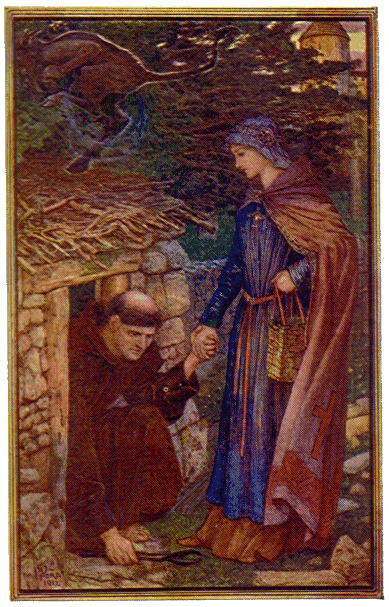
After some time the bishop had him ordained priest and he was sent abroad to a Benedictine monastery to study. When he returned to England he had clearly become something of a fanatic for he built himself a tiny cell too small even to stand up in and resolved to spend the rest of his life there contemplating God. He fasted to excess and it may be this that gave him visions of the devil who mocked and tempted him so much while he was at his devotions that eventually an exasperated Dunstan seized the devil by the nose with a pair of tongs and sent him on his way. This may sound like another apocryphal story but it is a fact that those who seriously set their feet on the spiritual path are the subject of attack by dark forces who seek to derail their attempts to come closer to God. Nowadays this may not take such an obvious form, so no need to buy a set of tongs just yet, but nonetheless it still exists.

Though Dunstan's intentions were undoubtedly sincere this was not a healthy way of life to sustain for very long. It is not untypical for a spiritual neophyte who is trying to take the Kingdom of Heaven by storm to become a little fanatical but growing experience should bring one to the realisation that a more balanced approach brings better results in the long term. Luckily for Dunstan, in a story reminiscent of one from the life of the Buddha, who was similarly saved from excess by a young girl who gave him some milk when he had fasted almost to death, a lady of the court persuaded him that it was his spiritual duty to help others rather than concentrate entirely on himself.

The sensible woman gets Dunstan to leave his cell.
Note the tongs and fleeing devil!
While still a young man Dunstan was appointed abbot of Glastonbury. He also came into great wealth as a result of some inheritances, and he used this to develop the abbey, building a new church and drawing up a set of rules for the monks based on that of the Benedictine order. Once again he became so respected for his wisdom and intelligence that his advice was sought by King Edmund and then, after Edmund's assassination, by Edred his successor. But when the 15 year old Edwig came to the throne Dunstan fell out of favour and was obliged to flee to Flanders before being summoned back when Edwig's brother, Edgar, became King of Mercia.

Dunstan was now held in such high regard that when the incumbent Archbishop of Canterbury died he was made Primate of England. He used his power and influence with the king to bring about many reforms, both spiritual and temporal. Monks were encouraged to dedicate themselves properly to the holy life, something that had not always been the case at a time when becoming a monk was often used as an excuse for an easy life of indolence, simony (buying and selling of ecclesiastical privilege) was outlawed and so was the nepotism that had been rife amongst the clerical community. Dunstan also ensured that the poor were able to seek justice before the king, and that copies of the Bible were written and placed in the churches so that priests could more properly teach their congregations the facts of the Christian religion. He even required the king, as an act of penance, not to wear his crown for seven years and the king actually submitted to this, such was his respect for the archbishop. At the end of this time Dunstan devised a new coronation for the king and the form this took is still the basic pattern for the coronation of British monarchs today.

The monk at bottom right has been identified from the inscription as Dunstan and the whole drawing may be by him too.
After Edgar's death Dunstan's influence at court waned and he retired to Canterbury to spend his time in prayer and good works of a more mundane nature.  He built churches and set up schools, worked to improve the lot of widows and orphans and practised the crafts in which he had always shown great skill. He made bells and organs and illuminated manuscripts. (Above is an example of what may be his work from the Glastonbury Classbook now held in the Bodleian Library.) But on the eve of Ascension Day 988 he was told by angels in a heavenly vision that he had just three days left to live, and to prepare for his passing. Sure enough three days later Dunstan died. He had served numerous kings and had contributed much to the wise running of the country. Unlike many saints he lived his life in the public eye, making laws for the good of the Church, trying to heal division, reform religious practice and bring together the warring English factions of the time. His is not a life like Cuthbert's, filled with miracles and wonders and largely devoted to contemplation, but one lived serving God in the outer world just as the lady who had persuaded him to leave his cell when he was still a young man had suggested he should. There is room for both sorts of saint.


Thursday, 8 December 2016

Charles Morgan: England's Forgotten Platonist


Charles Morgan (1894-1958) was an English novelist, playwright and essayist. He was born in Kent, studied at Oxford and lived most of his adult life in London. He was a household name in Britain, France and America during the 1930s, '40s and '50s, yet his work has disappeared almost without trace since, certainly in the UK.

Morgan's writing style is quintessentially English. One senses the cadences of the Book of Common Prayer and the heritage of the Romantic poets in everything he writes. Yet, paradoxically, he was honoured more in France than England, becoming an officer of the Legion d'honneur in 1936 and a member of the Institut de France in 1949. His essay France Is An Idea Necessary to Civilisation was highly influential in wartime France and feels especially relevant today as that country struggles to reforge her ancient identity and stave off a myriad of largely self-induced crises.

Morgan's finest book, at least out of those I have read, would probably be The Judge's Story (1948), a  flowing, harmonious tale of self-discovery, treating the profoundest of themes with the lightest of touches and calling The Tempest to mind in its meditative grace and distillation of the wisdom that comes with age.

The novel I keep coming back to, however - the one I'm always flicking through and brooding over - is The Fountain (1932), a 431-page epic that won the Hawthornden Prize in 1933 and was chosen as Book of the Month in the USA. The source material is primarily autobiographical. In 1914, Morgan was sent with the Naval Brigades to the defence of Antwerp. His battalion found itself lost, then trapped across the border in neutral Holland, where they were interned in Groningen. Morgan and a number of fellow-officers were then transferred to a secure fort at Wierickerschans, a fortress on an artificial island. He was there for a year, before being released on parole and sent to Roosendaal Castle, the seat of the aristocratic Van Pallandt family. Both castle and fort play central roles in The Fountain, though the Van Leyden family portrayed in the book is fictional. It was during this internment that Morgan first encountered the French language, culture and civilisation then still current in Dutch aristocratic circles and wrote the first draft of what became his first novel, The Gunroom.

Lewis Allison, the male protagonist of The Fountain, is a thirty year old British officer in exactly the same situation as his creator. A publisher by trade, and a former private-tutor, Lewis welcomes the quietness and opportunities for meditation internment will necessarily bring. He is writing a history of contemplative spirituality and is engaged on a search for stillness, inner focus, and what he calls 'singleness of mind'. The surprise appearance of an ex-pupil, Julie Harbury, now living in close proximity in Holland and married to a recuperating (though severely wounded) German officer, Rupert von Narwitz, disturbs Lewis's equanimity and sets the novel's plot in motion.

What follows is a sustained fictional meditation on the meaning of life - on the quest for holiness, authenticity and vocation; on our fallen world and the circumstances that sometimes separate us from those we feel called be with; on the social pressures that seek to silence the inner voice of truth; on the clash between individual desire and the demands of tradition; on the blessings of books and music, on a fraternity of the spirit that transcends war and national rivalry; on the fragility of human loves; on the immortality of the soul; and much, much more. 

There is, in short, a tremendous amount going on. Morgan takes his time in expressing it too. The pace is relaxed. Ideas and themes are left to marinate. Despite this, judging by one or two dust-jackets, it isn't always clear that publishers were fully in tune with the novel's premisses. It's certainly not the kind of story this cover tempts the reader with, for instance. 


Yes, there is an undeniable physical element to the love Morgan's protagonists feel for each other.  The Fountain, without doubt, is a highly erotically-charged text, but this is an eroticism transmuted by the intellectual and spiritual communion between the characters, this being the deeply Platonic context that animates and drives the narrative.

This cover, on the other hand ...


... creates far too genteel an impression. The novel is much more primal than this, reminding me, in many ways, of cities I feel particularly at home in, such as Liverpool or Rome, where one encounters both high and low culture with very little in-between. The younger members of the Van Leyden family are the closest depictions we find of the classic 'bourgeois' mindset - materialistic, staid, and unimaginative - similar, in their own way, to the Watson childrens' parents in Alan Garner's Elidor: too ensconced in newspapers and TV to be in any way aware of their offsprings' adventures on the borderland of the mythic and the everyday.

The illustration at the top of this piece remains my favourite due to the stylish art-deco ambience it conjures. The dust-jacket that best reflects Morgan's themes, however, is surely this one.


The artist evokes the tower on the Van Leyden estate where Lewis works on his history in the family library. He or she also taps into a fecund, archetypal stream in the art and literature of the British Isles. One thinks, for instance, of W.B. Yeats's lines in The Phases of the Moon

Far tower where Milton's Platonist
Sat late, or Shelley's visionary prince:
The lonely light that Samuel Palmer engraved,
An image of mysterious wisdom won by toil.

'The symbol of the tower,' writes Kathleen Raine in Yeats the Initiate, 'was passed through a noble succession, in direct descent from Plato, through Milton's Il Penseroso and Shelley's Prince Athanase to Yeats himself. Palmer too, whose last years were dedicated to his engravings of Il Penseroso, was a Platonist; and for Yeats, seeing on all sides the rise of ignorance, the most important thing was that one philosopher should still keep watch in the High Lonely Tower; as Plato, Milton, Shelley and Palmer had kept faith.'

It is this 'one philosopher' that Lewis strives to become, and it is this same Platonic worldview which animates in so many ways the oeuvre of Morgan's contemporary, C.S. Lewis, especially, one feels, in the Narnia books. 'It's all in Plato,' as Professor Kirke keeps explaining in The Last Battle. Plato, as we know, believed that the real, stable, permanent part of the universe exists in a supernatural, super-sensible 'heaven' of Ideas or Forms. The physical world, therefore, is a realm of appearances only - illusory and transitory - a shadow or 'copy' of the real world. But C.S. Lewis places his Platonic reality not in a far-removed, abstract heaven, but rather at the very heart, the centre of all that exists. The children, at the end of The Last Battle, go further up (to Aslan's country in the mountains, to the Platonic heaven) and further in (through one 'copy' of Narnia after another) then out onto a garden containing a Narnia that is better than all those that came before and at last to a Narnia seen from the mountains which is 'as different as a real thing is from a shadow or as waking life is from a dream ... Bless me, it's all in Plato.'

This is the garden, this is the 'Narnia', these are the mountains, which the characters in The Fountain seek and, in flashes at least, come close to discovering.

*******

The Fountain sold 100,000 copies. It seems extraordinary, looking back from 2016, that a novel of such density and erudition could prove such a best seller. It is tempting, perhaps, to speculate that this could never happen now - that reading tastes have degenerated to such an extent that a book like this would be practically unreadable today. I actually feel the opposite to be true and that, given the chance and the backing, the book might sell closer to a million copies than 100,000. Morgan saw himself as an inheritor of the Platonic tradition, and Platonism, as we have seen, revolves around something real and true; something that chimes and resonates with the human condition in every time and place and gets down to the very essence of who we are - this longing, this crying out of the human soul for a beauty and depth of experience which can only be found in Eternity and which this world, for all its charms and qualities, can never fully satisfy. Morgan felt this longing all his life. So did C.S. Lewis. So do millions of men and women in Britain today, cast off and left to drift in the post-modern void, their (and our) souls crying out for a dignity and nobility; a meaning, pattern and purpose - both individual and collective - which liberal, post-Christian society seems unwilling and unable to honour and even attempt to fulfil.

This is the deep yearning articulated in The Fountain; the book's primal scream of pain and hope. Contemporary readers would be delighted to encounter such integrity, I feel. Such intensity. But this is a style of writing and choice of themes which remains, for some reason, decidedly frowned upon by the powers that be in culture, media and the arts. No creative writing course, for instance, would recommend constructing a story in the style of The Fountain. Which is a shame. Because the Platonism given such stirring voice therein points to an end greater than itself. Just as Plato preceded Christ, helping creating an intellectual climate which would prove receptive to the Christian revelation, so today a rediscovery of the Platonic imagination could play a role in sowing the seeds of a Christian renaissance. Maybe that is why the powers that be show so little interest in Charles Morgan. Who can say? But let us conclude with a passage which highlights the singular nature, astonishing beauty and dynamic power - both dramatic and philosophical - of this remarkable book ...

******* 

'It is the consequence that matters,' Julie said, 'the consequence - not the intention. I didn't intend what I have done to Rupert or to you. I loved you.' She looked around the hut,  picked up a handful of pine-needles and let them stream over her palm. Outside it was raining still. 'The pardonable,' she continued, 'becomes unpardonable independently of us. The sin, though it seemed not to be a sin, grows to the stature of what we sin against. Its spiritual consequence leaps up and grows and burns like a forest fire. I see that now. There's no escape from it. None for ourselves; none for those we sin against,'

'Unless we pass through the fire.'

'Through it?'

'Unburned.'

'That is for the gods,' she said. 'Even Rupert is failing. It was to have been the miracle of his life that he should pass unscorched through every fire. He has passed through so much. But his love for me has trapped him ... Now, at any rate,' she added in a voice of anguish and relief, 'we need not be silent. We can go to him and say - '

'Not now,' Lewis answered. 'Give him time not to fail, Julie. He has transcended every other loss. He is beyond any help we can give or any reparation we can make.'

He said this so quietly and with so profound a passion that Julie, hearing again in his voice that ring of devotion and exultation which had first set him apart from other men in her eyes, turned to him in sharp wonder, in the delight of rediscovery. 'You love him,' she exclaimed. 'You could not speak like that if you did not love him.'

'As a pupil loves his master,' Lewis replied, and, going out of the hut, he looked up through the branches to the sky, seeing that the storm had passed. The branches, even the highest moved little. The wind had dropped and between the western beeches a reddened sun was slanting into the wood. Julie also came out, and stood beside him.

Through showering sprays they went on to the moor. As the gloom of the copse fell back and the heat expanse of the evening sky shone upon their faces, they were touched by the blissful awe of those who, in the instant of beauty or love, are bound in  a common wonder and look deeply into one another and speak silently as they cannot at other times. For the spirit of man is blind and dumb except God touch him, and awake, in the winter of his flesh, the spring of immortality.

The air, cooled and polished by rain, had that transparency with which at sundown on wet evenings it is sometimes invested, as though the substance of it had been drawn away and there remained between earth's floor and dome only a lucent emptiness edged with crystalline fires. Soon the crystal would be stained by dusk, the forms of earth thicken and night flow on; but for a little while the trees dreamed above their shadows and time slept. Lewis and Julie waited. At last, when the heather had begun to darken, they set out towards Enkendaal.