A terrific realisation of the reality of life... A recognition that we live in a world of beings; that we personally are placed here for a purpose.
(To know our true thoughts; that all such thoughts are true. To realise that such thinking is imagination; to recognise imagination and know it as true thinking. And truth as universal - to live from that knowledge.)
*
When the change came there were signs. The sun was different, the moon also - the airs and winds and waters... because all are sentient and knew (in their way) that the time had come. The very earth, too - in its slow vast movements.
Invisible waves, forces, radiations also changed. Everywhere there were signs - for those who could think, and knew their thinking to be true.
As for the others - well, their dreams knew; whenever their egos were stripped away, their emotions knew.
The children knew - the younger they were, the more they perceived it.
But the change was primarily in Men - because that is reality; that is how creation is organised...
There was change - the choice was recognising this change - and it was a change in thinking. It was not, essentially, out-there - and it did not impose itself on people. It was deniable...
Some Men inverted their thinking, systematically inverted their evaluations, inverted their discernment. Shielded their real selves and thought by inculcated habits - or refused to think for themselves, to know for themselves.
True thinking was consciously prevented.
*
The great awakening we all await (or have been pre-programmed to ignore) is mostly a sudden and convinced awareness of the true nature of life; and a rapid, decisive, appalled turning-away-from the ubiquity of superficial, pointless distractions and lies.
We first must know the way things are, understand the great issues that confront us, the nature of our situation.
Then we will each decide.
Decide which side we will join - or opt-out.
Tuesday, 1 August 2017

Shakespeare, Blake and Albion's mission

Portrait of Wm. Shakespeare by Wm. Blake
The nations and races, and certain historical individuals born into them, have their special relation to each stage in the evolution of consciousness. Thus Rudolf Steiner often said that the English nation is the nation of the Consciousness Soul.
[Consciousness Soul = the modern, materialist, alienated state].
England is the island nation; it is England whose greatest writer creates a marvellous gallery of individual 'characters' - every conceivable type of man except the mystic; it is England out of which the scientific spirit arises; it is England who, alike in sport and economics, sees the world as an aggregate of free competing units; and it is the English speaking peoples who, for good or ill, are taking the lead in the present age; which is the age of the Consciousness Soul.
To say this about the English nation is not to suggest that it is ultimately more important in the scheme of things than any other nation; it is to suggest that in the present age it bears a specially heavy responsibility.
What signs are there that England may live up to her responsibility and perform her mission? She can only do this by a right development of her consciousness; for out of consciousness all free actions spring.
If there are any signs at all that England may live up to her responsibility and perform her mission [written before 1944], these are at present to be found not in the centre but at the periphery; not in the public man but in a few private men; and not so much in the town as in the country.
Perhaps the growing popularity of Blake's 'Jerusalem' heralds a dim awakening of purpose? The problem of the right action of England must be connected with the right development of the Consciousness Soul; and Blake seems, in a remarkable way, to have felt himself the spokesman of this development.
Blake is really complementary to Shakespeare; because if Shakespeare represented every kind of man except the mystic, Blake could apparently conceive of no other!
To Blake, logic is something that has to be, not ignored, but conquered: overcome. Imagination and the redeemer are almost synonymous; and Albion is a symbol for universal Man.
Logic and the experience of Nature as 'matter' and unfree morality based on the law emanate from the Daughters of Memory. But the Daughters of Memory are to be overcome by the Daughters of Inspiration, who are also Jerusalem.
Nature is to be redeemed by Imagination, is to become Imagination.
What does it mean to 'build Jerusalem in England's green and pleasant land'? What can it mean except to rise from the Consciousness Soul to the Imaginative Soul?
[Imaginative Soul = what Barfield later called Final Participation.]
The 'Satanic Mills' which have arisen in England since Blake's time, will never be thrust down from their hideous tyranny until those Mills of which he actually sang (that is, the dead thinking of Newton, Locke and Hobbes) have been burst asunder from within.
Edited from pages 63-66 of Owen Barfield's essay 'Speech, Reason and Imagination' from Romanticism Comes of Age, 1944. My notes are in square brackets.

The assuaging of the waters - by John Martin
Saturday, 29 July 2017
We must go it alone - no institution will serve...

This is, indeed, the impossibility I confront: that modernity (secular Leftism) is the tool of evil, and orientated ultimately to destruction of The Good; yet traditional religion has become an impossibility at the mass social level, partly for reason of wrong choices (such as the sexual revolution); but not entirely so.
It is consistent with observation (but of course not evidentially-proven; that being impossible) that the grounds for mass religiousness in The West have simply, inexorably, dissolved-away over the past couple of centuries and the Christian churches are now either fundamentally-corrupt or else intrinsically-elite --- that is my interpretation.
That around 1800, in the industrialising nations, a new impulse came upon Men that we usually term Romanticism; which was (at its heart, and at its best) against both the unspirituality of traditional Christianity and also against the arising materialism and Leftism. Romanticism was supposed to be the spiritualisation of all life in context of Christianity; but unfortunately it split into (approximately) anti-spiritual Christianity as a form of social organisation on the one hand; versus an unChristian spirituality that ran in-parallel-to (unintegrated with) materialism in the political sphere and the gratification of non-spiritual emotions (the desire for prosperity, novelty, sex etc).
Romanticism is unfinished business. It was supposed (and by supposed I mean divinely-destined) to be the future of humanity; but that path of spiritual, 'magical' Christianity was refused.
Since then, Life has become compartmentalised; the great mass of people (rulers and ruled alike) have become ever more alienated, unrealistic, incoherent; distracting emotional escapism and pragmatic matter-of-fact despair have become the twin mainstream cultural expressions.
The only possible future is to finish the business of Romanticism. And, at this point n history, there is no group or institution doing this in The West; so if we want to do it - if we regard this as our divine destiny, then we must each do it solo.
And we cannot follow a path, because no path is laid down; we need to find our own path. We know where we want to be: that is living the Christian life in clear, coherent and continuous awareness of both the spiritual context of creation and creator; and within this the living, conscious nature of ourselves and the world around us: in a phrase animistic Christianity...
But we don't know how to get there - or even how to take the next step towards that goal. This situation is the cumulative consequence of two centuries of evasion and corruption; the consequence of living in a society of lies where any advice we take is almost certain to be wrong; any knowledge we acquire is almost certain to be wrong; and directions we are given almost certain to be pointing back down the same path on the down-conveyor belt, or into the abyss.
We may take clues from the insightful early romantics: Blake, Wordsworth and Coleridge; Goethe and his interpreter Rudolf Steiner - and Coleridge and Steiner's interpreter Owen Barfield... but they do not yield a blueprint or program.
It seems that part of the divine plan is that we each develop spiritual autonomy and Christianity both; that we do this for ourselves and from ourselves - and do so without any clear knowledge or assurances or examples of where we are going or how we might get there.
Instead of clear knowledge we have hints and lustres, and an awareness of our inner freedom or agency yielding direct conviction - which is not solid and insistent in the same way that social institutions are, due to their material power and simplistic inertia. To withstand these pressures, and do do so without fear and with faith, requires a very solid and strong trust in God and his love; and our capacity to know God's nature and motivations - and that can originate only from personal experience.
Friday, 28 July 2017
Seeing is Not believing (only direct knowing is true, potentially)

Why don't we see angels anymore, like people used to do in the past?
Well, some people do sometimes - but most people can't ever; and among those that do see angels, the results are not usually impressive, so it doesn't seem to do them any good (at least, not so as convince other people).
The idea is seeing is believing, is related more generally to the common modern belief that perception is reality; the idea that what is real is what we see, hear, touch, taste, smell - and perceiving is how we know it is real. And, if God, angels, divine things were real, then we would perceive them; and if God was real he would therefore show himself, give signs...
So modern people point at the lack of 'evidence' for God... Yet when there is the evidence of people reporting sensory contact, it is disbelieved - it is put down to hallucination, self-deception, fraud...
Indeed, people disbelieve their own perceptions, quite routinely. They believe the mass media rather than what they perceive, what they experience...
Furthermore, in science, what is perceived directly is of very little relevance - and the 'observations' are done with machines of various types, and often after very complex statistical manipulations. The validity of the machines and statistics is a matter of faith (faith that is generally misplaced).
So the situation is that people use the notion that seeing is believing to reject things that they want to reject - like God, or angels; but lack of perceptual evidence is no barrier to accepting things that are socially sanctioned (like the belief in reversible anthropogenic global warming, which has transformed all of our lives - for the worse) .
*
But seeing is Not believing, and perceptions are not the bottom line - we know that! We know that perceptions provide only indirect knowledge, that they are partial and distorted; and may be unique to the individual (hallucinated). We know about optimal illusions, we know that we can't see ultra-violet light but it is there, we know that colour depends on our physical makeup and can be altered by ambient light or tinted spectacles... we know that seeing is not believing - or should not be.
Indeed, we know that we are being manipulated by fake images all the time - whether in the movies or in the 'news'. If we believed what we saw, we could be made to believe anything!
*
Taking this further, many people are aware that most of the whole world of public discourse is manufactured. That much of what we are shown, much of what we are provided with 'evidence' for, is fake, false, manipulative. There are systematic forces at work behind the scenes to create virtual realities using images, fake evidence, false logic and so on...
All perceptually-derived knowledge is mediated - and this enables it to be manipulated.
*
So what should we believe? In principle, only what we directly know. Only what we know without mediation.
What we believe ought to be that we we do not perceive, for which we have zero evidence; that which is now without use of reason, logic or inference.
That which is intuited.
Think about it.
Thursday, 20 July 2017
Heddon Hill and Ingram church - John Michell semi-vindicated
On a recent walk I looked again at Heddon Hill in the Breamish Valley, Cheviot Hills, Northumberland:
 As you can see, there are very striking terraces on the left of the hill, and these are partly obscured by later vertical ridge-and-furrow ploughing in the middle section - better seen here:
 These markings are described on the OS Map and in guide books as 'cultivation' ridges - with varying estimates of age; from medieval right back to pre-Roman... who knows, the hill hasn't been excavated (and such excavations usually show features to be much older than expected, sometimes by thousands of years).
Looking at the 'terraces' I thought of the appearance of Glastonbury Tor and its 'terraces' - or as some - including John Michell - would have it... Ceremonial Labyrinth.

Could the distinct terraces on Heddon Hill actually represent the remains of a labyrinthine path? Ascending to some 'temple' at the summit?
Michell's idea was that such features were often dedicated to a pagan deity whose identity was replaced by the angel St Michael; thus the ruined tower on Glastonbury Tor was from a St Michael's church. Michell then suggests that prominent sites dedicated to St Michael formed a straight line alignment (a Ley Line; some kind of energy flow, supposedly) across England:

Well, with such thoughts swirling; I was surprised to find that the very nearby church in Ingram, in the Breamish Valley, was also St Michael (and all angels)... 'Perhaps' the church in the valley replaced the temple on the summit a few hundred yards away?
So we have several Michell-esque ingredients of an 'alignment' or Ley Line here! The next step would be to get out the maps, a pencil and a long straight edge. But I have not yet taken the matter any further...


Looking at the 'terraces' I thought of the appearance of Glastonbury Tor and its 'terraces' - or as some - including John Michell - would have it... Ceremonial Labyrinth.

Could the distinct terraces on Heddon Hill actually represent the remains of a labyrinthine path? Ascending to some 'temple' at the summit?
Michell's idea was that such features were often dedicated to a pagan deity whose identity was replaced by the angel St Michael; thus the ruined tower on Glastonbury Tor was from a St Michael's church. Michell then suggests that prominent sites dedicated to St Michael formed a straight line alignment (a Ley Line; some kind of energy flow, supposedly) across England:
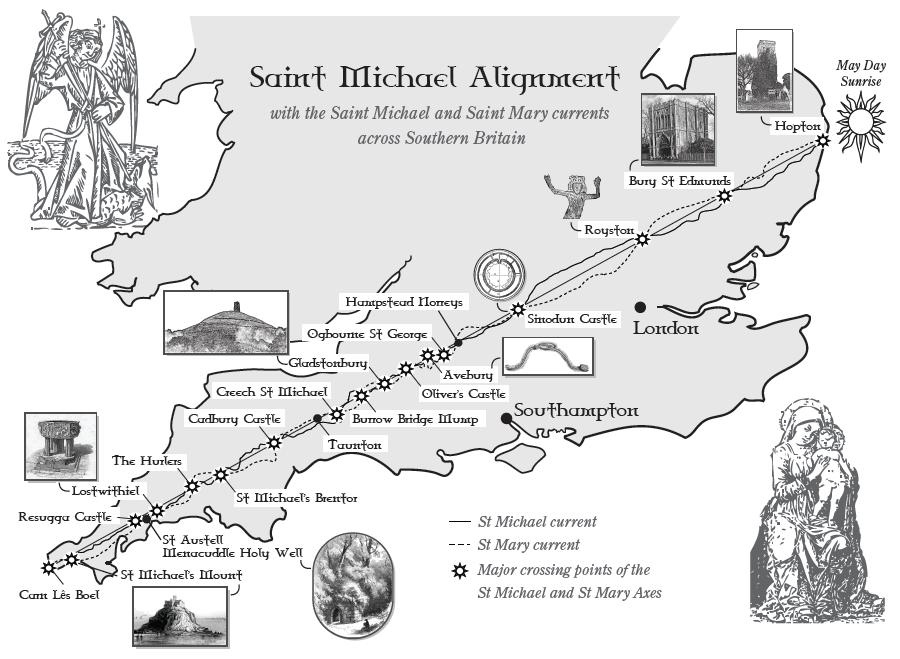
Well, with such thoughts swirling; I was surprised to find that the very nearby church in Ingram, in the Breamish Valley, was also St Michael (and all angels)... 'Perhaps' the church in the valley replaced the temple on the summit a few hundred yards away?
So we have several Michell-esque ingredients of an 'alignment' or Ley Line here! The next step would be to get out the maps, a pencil and a long straight edge. But I have not yet taken the matter any further...


Wittgenstein and Christianity, and his late corruption
I have been reading Ray Monk's biography of Ludwig Wittgenstein - and found the first part very useful and helpful; but had to stop reading soon after Wittgenstein's return to Cambridge in 1929 with his commencement on revising his earlier views expressed in the Tractatus Logico -Philosophicus (published in 1921)...
I had to stop reading because the corruption of Wittgenstein, and his malign effect on so many other people, became too painful to continue.
My understanding is that Wittgenstein was - until shortly after the 1914-18 world war - a deeply religious man who was on the verge of being fully Christian but never crossed that line; after this time his work was a massive, nihilistic rationalisation of his rejection of Christianity.
Metaphysics was at the root. In Tractatus, Wittgenstein wrote a primarily metaphysical book but made the error of assuming that logic was the basis of all philosophy; this he excluded metaphysics from philosophical communications (he continued, avidly, to speak about metaphysics outwith his philosophical work); not because it was unimportant - quite the contrary, but because it was not part of logic.
In Tractatus Wittgenstein made an arbitrary but unjustifiable decision to assert that on the one hand logic could be apprehended by direct knowing ('seeing) but that metaphysics could not ('saying'); therefore he asserted that logic was communicable but not metaphysics.
But there is no reason why metaphysics could not be directly apprehended in exactly the same way that the basic, atomic propositions of logic can be apprehended; therefore there was no reason to exclude metaphysics. However, this was one point on which Wittgenstein became inflexible - he revised almost everything in his philosophical 'system' but not the exclusion of metaphysics.
For Wittgenstein - nothing knowable was really-real.
Thus Wittgenstein's proto-Christian religion was subverted; because Christianity became merely a psychological state. For example, he repeatedly said to many people that while he respected the Roman Catholic Church (in which he had been brought-up) he 'could not' believe all the necessary parts of doctrine.
Wittgenstein seems on the one had (by his repetition of it) to suppose he has said something profound here; yet also seems to be unaware that his personal inability (on a particular day) to believe in something is what is truly subjective; and that the proper question was whether or not that 'something' is true, is really-real!
(Who cares what Wittgenstein happens to think today about Transubstantiation? He often changes his mind! - The proper (metaphysical) question is whether Transubstantiation is a reality, or not? The exact answer 'yes' or 'no' is not (in my opinion) essential to being a Christian; but any Christian must regard this question as a matter of being about-reality, not of being about-individual-human-psychology.)
As a further, and deeper, example: Wittgenstein in his early life correctly recognised that true Christian loving-faith 'casteth out fear'. He was deeply fascinated by accounts which showed that deeply faithful Christians were not worried about the future, about what 'might happen'...
He saw that fear is, in a deep sense, the opposite of love: if we truly believe in the Christian God (creator, god of love, personally concerned by us his children) then there is no ultimate reason to fear anything.
But, Wittgenstein came to regard this 'fear' as a psychological state purely! When the proper understanding of evil-fear is a kind of existential angst; the fear that is cast-out by faith is not merely a human emotion (which in this mixed world is unlikely to conform to any ideal) but the ultimate assumptions concerning the nature of the world.
It is, most exactly, metaphysical fear which is cast out - it is the assumption that fear has a necessary place in our lives that is cast-out by Christian love, by faith in the loving-nature of a creator god.
Wittgenstein went from rejecting speaking about metaphysics in his early work (Whereof one cannot speak, thereof one must be silent." were the final words. The error is in the word must.); to rejecting all possibility of metaphysics in his later work - in which everything reduces to (current, evanescent) psychology, to therapy, to 'usefulness', to 'life' (to 'language games').
Wittgenstein made it impossible for himself to become a Christian; and thereby damned himself and everybody else who took him seriously and deeply. He also made many people (especially those closest to him) very miserable in this mortal life (and did not seem to apologise, repent or even notice the fact; unlike earlier in his life) - consistent with demonstrating that the exclusion of metaphysics does have distal consequences.
And that is why the second half of Wittgenstein's biography is too painful for me to read...
Tuesday, 18 July 2017
Leftism and Reason
A commenter on Bruce Charlton's blog objected to my statement in the last post that leftism is a rational ideology according to its own materialistic bias. He thinks it is fundamentally unreasonable. I don't disagree. I did say it was often held by people whose beliefs were based on what they wanted to believe, and my use of the word ‘ideology’ was also meant to imply disapproval. I see ideologies as intellectual constructions bearing little or no relationship to reality. The world has no need for ideologies formed by theorists with spiritually desiccated minds such as Karl Marx or any number of minor 20th and 21st century academics.
But what I meant was the difficulty of arguing purely rationally against leftism from within the framework it has set up for itself and which now seems to be increasingly accepted. From a more universal framework it's not hard to argue against at all, but if you accept the absolute materialism of the leftist there are readymade assumptions built into that which tend to be self-supporting for the leftist thesis.
Of course, materialism is irrational as I have written here, and I certainly was not saying that leftism is rational in any true sense. It's clearly not. In my view it derives from the rebellion against, first, natural authority, and then, and ultimately, God and the idea of being a creature. Reason for the leftist is pressed into service to support his prejudices, but if you accept the boundaries of the artificial world he has created then reason alone might not be enough to get you out.
If only leftists were honest about their motivations but they're not. It all goes back to the first one in the Garden of Eden who preached equality (ye shall be as gods) but only in order to destroy true hierarchy so that he might establish a new and false one, an inverted one in fact. He's still up to his old tricks, using apparently rational argument to promote them. It's only when we go beyond reason that we can fully see through them.
Subscribe to:
Posts (Atom)